Launching a podcast is less about gear than about method. In Nice, the ecosystem is small, costs are manageable, and the competitive advantage comes from consistency, not equipment. Here's how I advise clients to go at it, step by step.
I run a podcast studio in Nice and I get weekly calls from people who "want to launch a podcast one day". Half are stuck on the gear. The other half are stuck on distribution. Very few focus on the only thing that matters: shipping one episode, then shipping the next. This guide tries to put the priorities back in order.
1. Find an angle you can sustain for a year
Classic trap: pick a broad topic to reach a wide audience. "Business podcast", "wellness podcast", "tech podcast". These formats already exist by the hundreds, run by people who started before you.
The winning angle is narrow. More precisely: an angle where you are the only person in the room who can hold the conversation. Concrete examples I see working on the Côte d'Azur:
- Behind-the-scenes of Niçoise restaurants (chef-by-chef interviews, monthly format).
- French Riviera luxury real estate, told by a working broker.
- A therapist breaking down anonymised patient cases (with consent).
- A business coach following the same founder over twelve months, recorded every first Friday.
Simple test: can you write the titles of your next fifty episodes in under an hour? If yes, your angle is sustainable. If not, your topic is too vague.
2. Pick a format that fits your week
Three formats work well today at reasonable cost:
The solo (10 to 15 minutes per episode)
You talk alone. Short, dense, rhythmic. Ideal for showcasing expertise. Demands real written prep to avoid drifting, but it's the cheapest format to produce.
The interview (30 to 50 minutes)
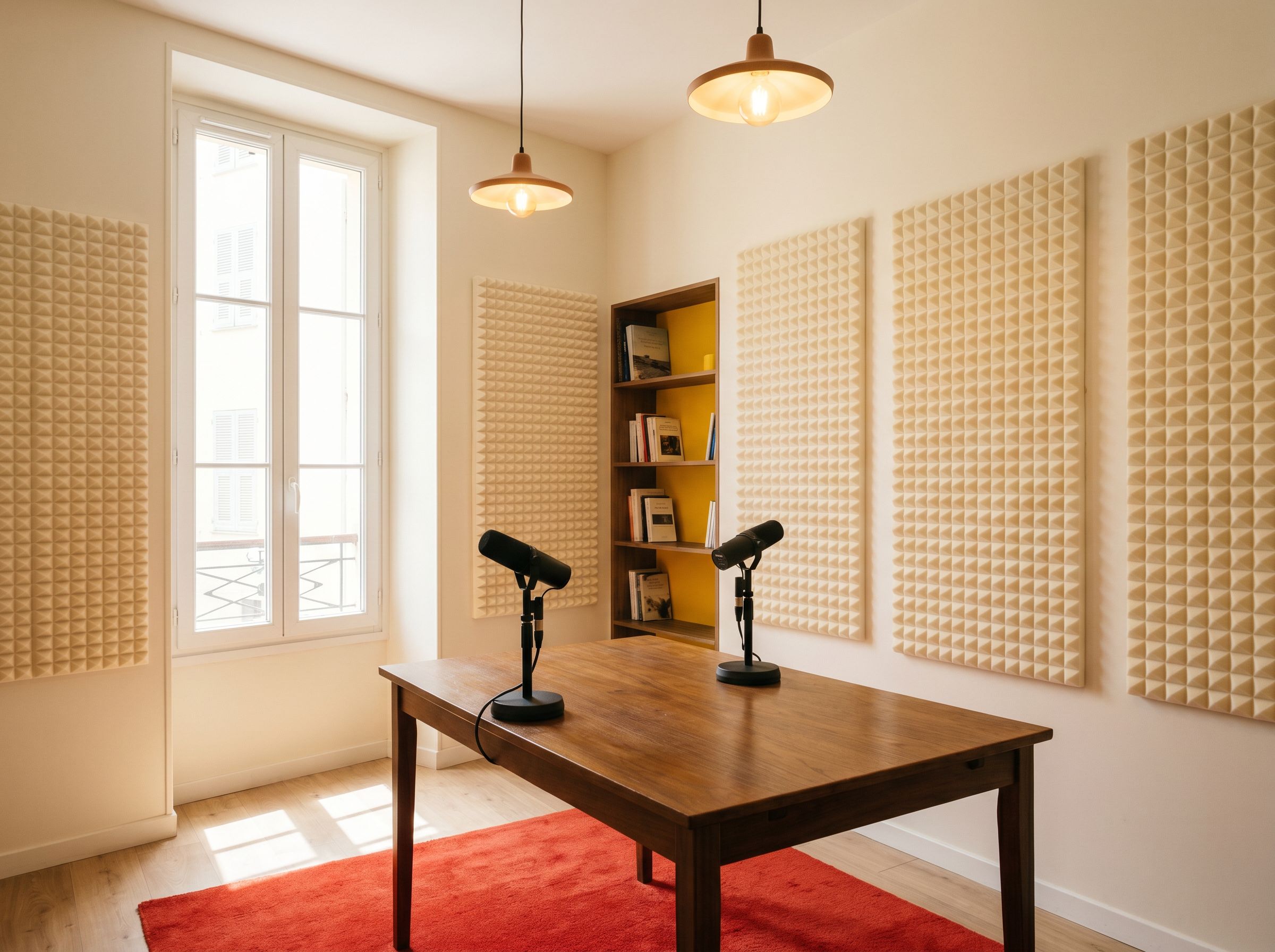
You host a guest. The most commercially accessible format because your guests share it with their audience. Requires a soundproofed studio: one motorbike outside and the episode is unlistenable.
The co-hosted (30 to 60 minutes)
Two voices that know each other, debate or conversation formats. More human, but requires lots of off-mic chemistry to avoid heavy tone in the final mix.
3. Gear: the honest minimum
You can start a listenable podcast with €200 of gear. You can also blow €5,000 on it. The quality curve plateaus quickly after the first €600.
Solo / home studio (€200 to €400)
- A Shure MV7+ (USB and XLR) at €270.
- A decent boom arm like the Røde PSA1 at €110.
- A closed-back Beyerdynamic DT 240 Pro headphone at €90.
- Some carpet or basic acoustic panels for the room.
Serious amateur studio (€800 to €1,500)
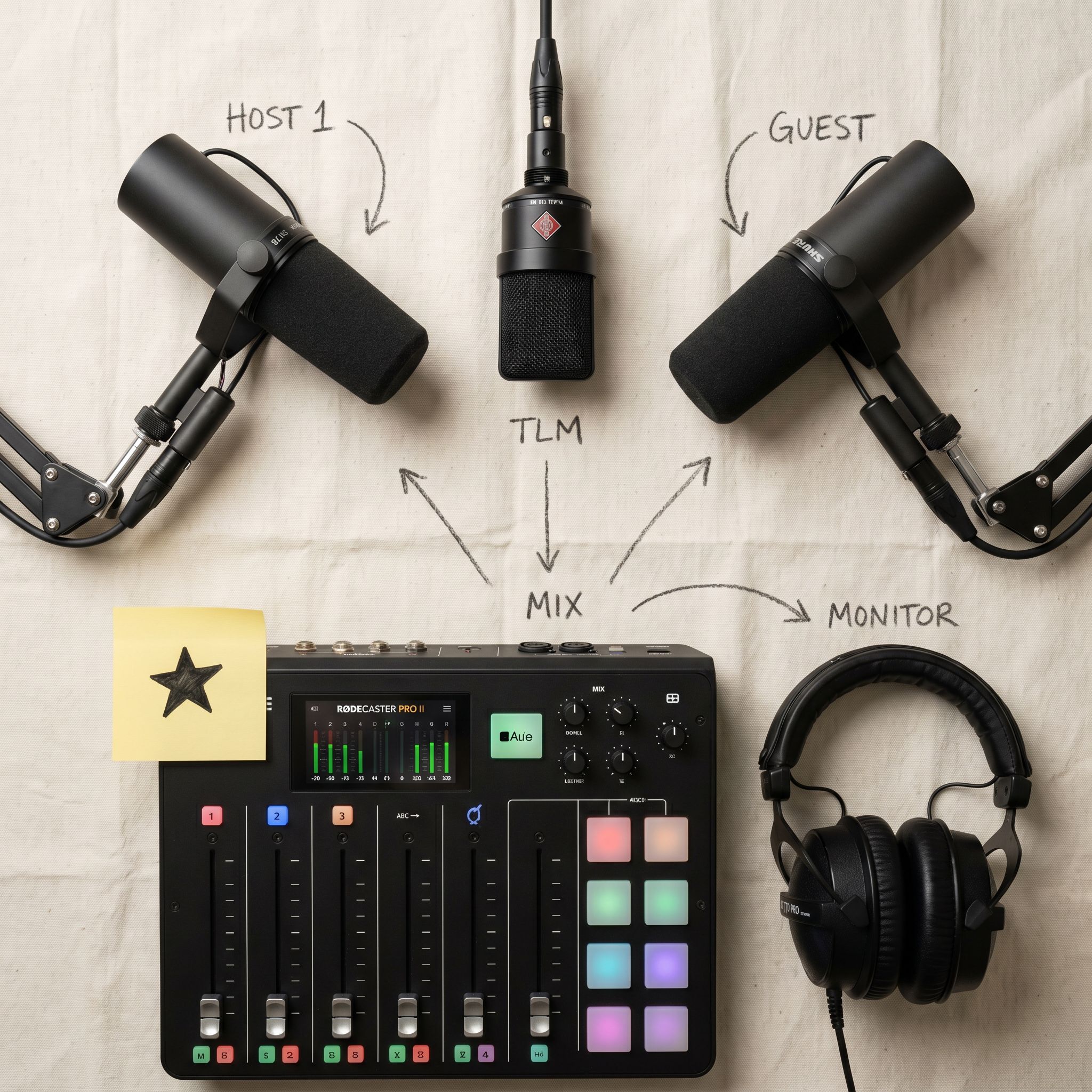
- A RØDECaster Pro II interface at €750.
- Two Shure SM7B mics (€400 each).
- Cloudlifter to push the SM7B gain (€220).
- Two Beyer DT 770 Pro headphones (€180 each).
Pro studio
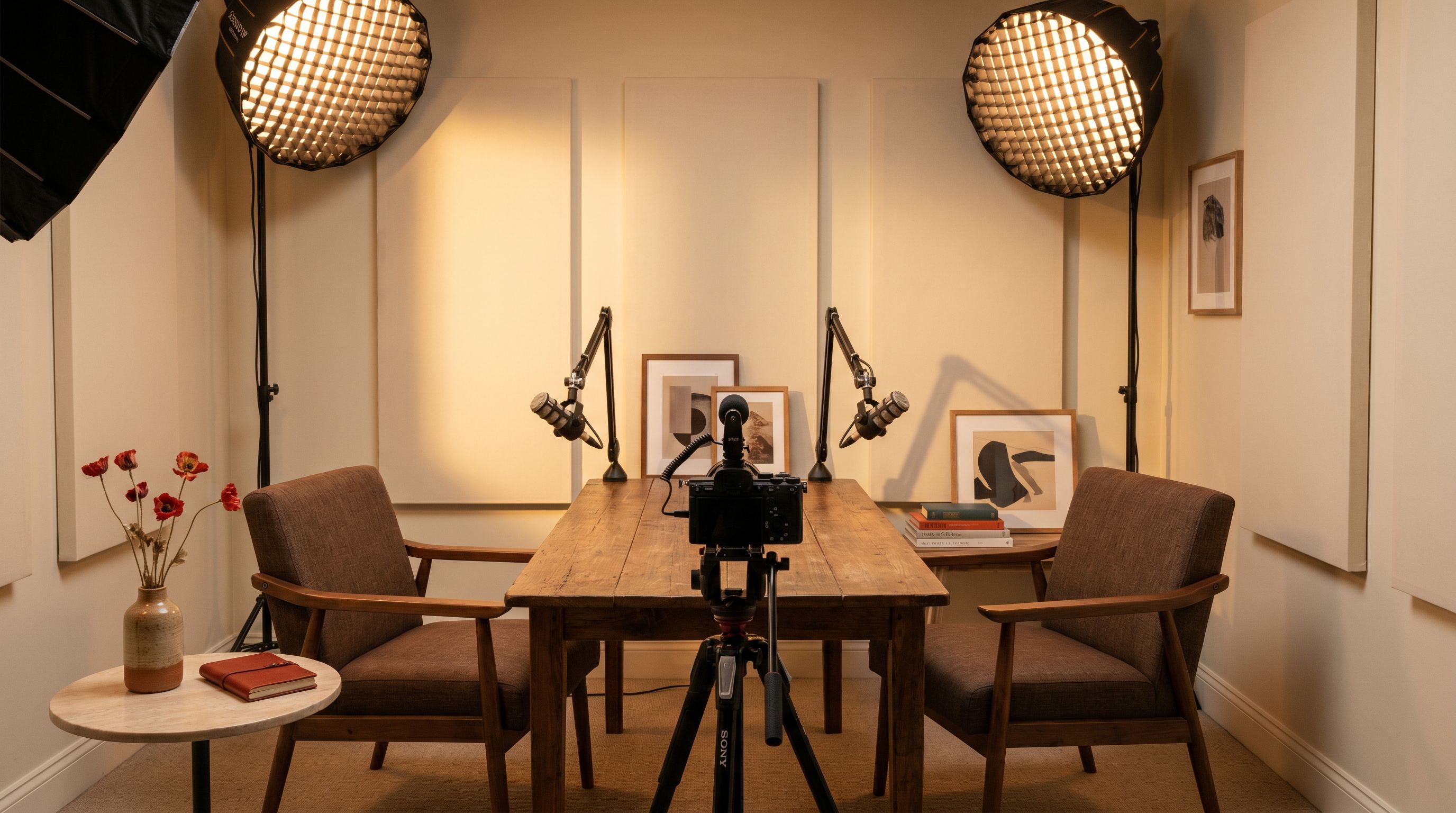
Beyond that, you're entering Neumann, SSL, cinema-light territory. Most podcasters don't need it until they've crossed 5,000 listens per episode, which is exactly why our Nice studio runs a RØDE PodMic XLR + RØDECaster Pro + dual Sony 4K chain. Same broadcast result on the ear, none of the capex weight that kills the project's economics.
4. When to move into a studio
Three signals tell you it's time to book a pro session:
- You spend more time editing than recording.
- You want to attack YouTube and 4K video is blocking you technically.
- Your guests start looking uncomfortable with your home setup, and the conversation suffers.
At Studio Nice Podcast, we design the session around your project, not the other way round. You tell us your angle, the number of guests, the desired vibe, and we calibrate the gear and the set accordingly. Let's talk on WhatsApp.
5. Distribution: the minimum list
Once the episode is ready, four things are needed for it to exist in marketing terms:
- An RSS feed: hosted by Acast, Ausha (French), Spotify for Podcasters (free), or Transistor. €0 to €15 per month.
- Directory presence: Apple Podcasts, Spotify, Deezer, YouTube Music, Amazon Music. All free, submit once.
- A video version: YouTube became in 2026 the top podcast discovery engine in France. Not being there means ignoring a third of possible listens.
- Shorts: Instagram Reels and TikTok for punchy extracts. Three shorts per episode is a good rhythm.
6. Consistency: the only metric that matters
Every podcast that works has one thing in common: it ships on a predictable schedule. Not necessarily weekly. But Tuesday at 8 AM, or the first Friday of the month, or in eight-episode seasons. Audiences learn to wait.
Conversely, the podcast that ships "when I have time" dies at episode 6 in 90% of cases. The studio you choose must be able to take you in when you want, not three weeks from now. That's also why we keep short slots available in Nice.
Don't launch a podcast until you've written ten episode titles. It's the smallest public commitment you can make to yourself. If you stall at six, your topic isn't the right one.
The five most expensive mistakes
- Buying gear before recording ten pilot episodes on a phone.
- Outsourcing the edit to cheap sites that return a compressed file without mastering.
- Not defining a target duration: episodes floating between 22 and 78 minutes kill loyalty.
- Refusing to cut. A well-edited 35-minute episode is better than 50 raw minutes.
- Launching six podcasts in parallel. Pick one, ship twelve episodes, then evaluate.
Local resources in Nice
Underrated but useful: on the Côte d'Azur, you can lean on three ecosystems on top of the studio. The SecondHome and Wojo coworking spaces in Nice host outdoor interview sessions when the weather allows. Several French Tech incubators welcome podcasters in residence. And the Riviera Startup community runs a first-Thursday-of-the-month event where quality guests are easy to find.
For the studio itself, we're at your service. The Pro session at €399 covers almost any launch-phase podcast need. And if you just want to chat, our WhatsApp answers under 30 minutes.
If your launch needs the studio to come to you, see our on-location podcast and video setup, or run it yourself with podcast and camera gear rental in Nice.