In 2026, close to one third of podcast listens in France happen on YouTube. Skipping video means leaving an entire audience channel on the table. For podcasters based in Nice or around the Mediterranean, the context works in our favour, if you know how to use it.
Why video changed everything
Spotify, Apple Podcasts, and Deezer remain the dominant audio platforms. But looking at 2024 to 2026 trend lines, YouTube absorbs the growth. The reason is simple: a human face holds attention better than a static audio thumbnail. The YouTube algorithm learns in real time what your audience wants. And vertical shorts cut from video sessions loop on Instagram and TikTok.
Concretely, the same episode produced audio-only will reach a ceiling X. The same episode shot in 4K video + horizontally edited + sliced into three shorts reliably reaches 3 to 5 times that ceiling. At a marginal cost of €200 to €400 per session.
The specific advantages of Nice and the Côte d'Azur
Shooting a video podcast obviously isn't unique to the Riviera. But four local elements work in favour of creators based here:
1. Natural light, nine months a year
From March to November, light in Nice makes video easier to grade than in Paris or Lille. A correctly placed camera near a window needs two-thirds less artificial lighting. Over a four-hour session, that's time saved and a warmer final render.
2. High-profile guests pass through Nice
NCE airport is France's second-largest. Executives, athletes, artists, international founders land here every week, often for 24 to 48h. A podcast studio near the city centre becomes an opportunity location for interviews you couldn't get otherwise.
3. The backdrop
On camera, a Mediterranean setting reads better than an anonymous Parisian open-space. Indoors (warm light, noble materials, Riviera art references) or in B-roll (sea, old town, market), the Côte d'Azur provides a recognisable aesthetic. That's a brand asset for your podcast.
4. A podcast ecosystem under construction
Nice isn't Paris or Marseille. Competition is weaker, creator-to-creator help is stronger. Finding a guest, meeting an editor, negotiating a co-production. It moves faster here. An advantage that won't last forever. The window is now.
The technical setup we use
For a video podcast to be publishable on YouTube without retouching every episode individually, you need a minimum kit. Here's what we deploy in the studio for a Premium session:
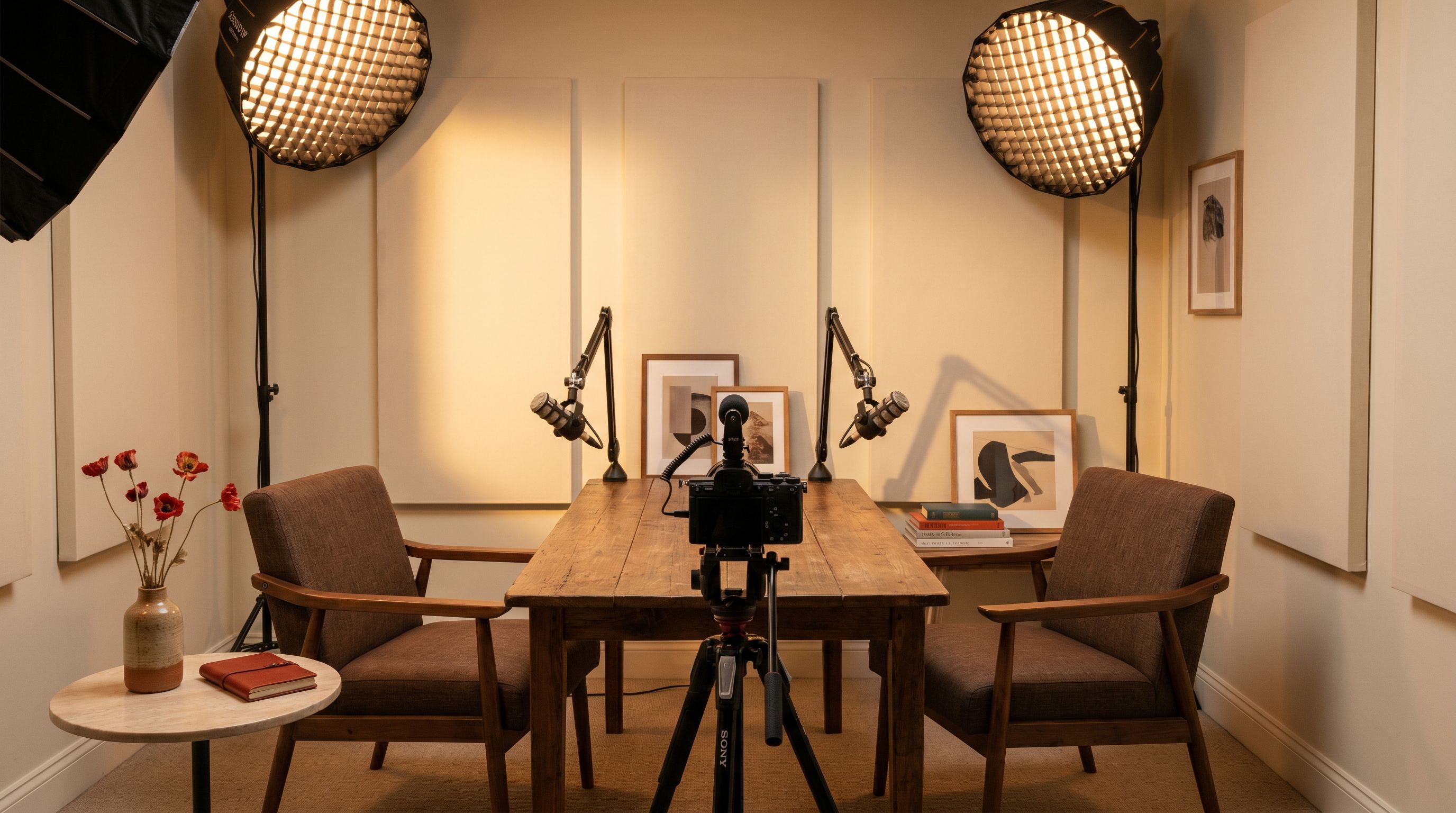
- Cameras: two Sony 4K (wide + tight shot), on fluid tripods for the seated format.
- Lighting: warm-light softbox key + colored LED accent in the background for the cinema-feel separation.
- Audio: two RØDE PodMic XLR on boom (broadcast dynamics, same family as the SM7B), routed through a RØDECaster Pro with closed-back monitoring.
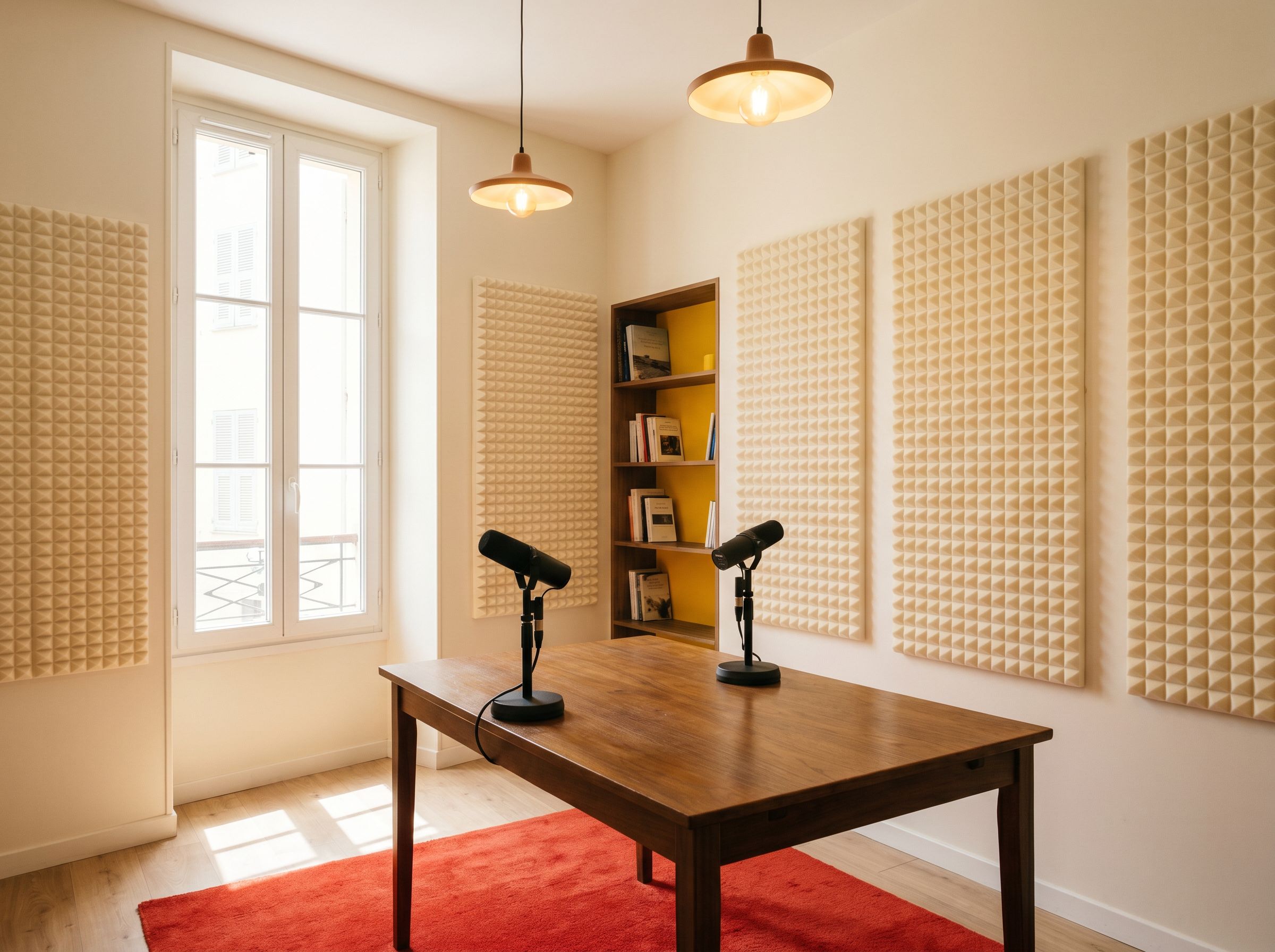
- Acoustics: wall denoiser panels to kill reverb and street noise.
- Post-production: DaVinci Resolve for edit + coherent colour + burned-in captions (or raw export if you cut at home via Riverside / Zencastr).
For reference, an equivalent kit bought outright costs around €12,000. That's why it's rarely worth investing in your own video kit before validating that video actually brings audience to your specific podcast. Better to rent three or four sessions and measure the return, then arbitrate.
How to think a video session
A video session isn't an audio session with a camera added. Three practical differences:
1. Visual prep matters as much as the script
Outfit, background, mic position, props on camera. One badly thought detail (a cable crossing the frame, an oddly placed water bottle, a polka-dot shirt) ruins fifty minutes of good content. We send a prep brief to all our video clients 48h before the session.
2. Ad-reads should be recorded separately
So they can be swapped later without re-recording the entire episode. Standard practice among big podcasts since 2023.
3. Shorts are cut in the room, not in post
While the conversation happens, we mark punchy passages as short candidates. Three shorts per episode on average. We export them the next day in vertical with burned-in captions.
The good test for whether your podcast should move to video: have you ever had a guest decline because it would be on YouTube? If yes, that's exactly why you should do it. You'll attract more mature guests in the format. Otherwise you risk shooting with the same circle for three years.
How much it really costs
At Studio Nice Podcast, video is included as an option in the Professional package at €399 and standard in the Premium package at €799. For a podcast shipping one episode per month, that's between €4,800 and €9,600 per year, less than a single agency-billed production day.
Next step
If you're hesitating between switching to video on your next episode or waiting, let's talk concretely. WhatsApp in five minutes: you describe your current podcast, your audience, and your goal. I'll tell you honestly whether video will gain you audience or whether you wouldn't see enough return. No sales pitch, no commitment.
Filming somewhere other than the studio? We also run a corporate interview and brand video setup across Nice, Cannes and Monaco, and a short-form social content studio for the vertical clips that come out of a 4K shoot.